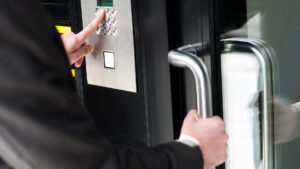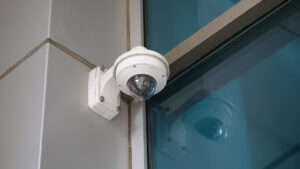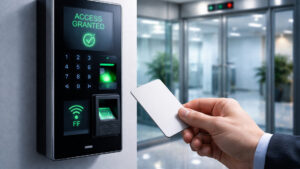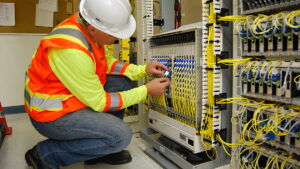
Choosing the right access control system depends on your business type, security requirements, number of users, and the areas you need to protect. Card and mobile access systems can work well for general office areas, while biometric systems may be more suitable for sensitive or high-security locations. The best solution is one that provides the right level of protection without adding unnecessary cost or complexity.
If you’re planning a new access control installation or upgrading an existing security system, it’s important to have the project properly assessed and installed by experienced professionals. The right access control technology, reader type, door hardware, network infrastructure, integrations, and user management process all need to be considered before installation. If you’re not sure which solution your business needs, you can always contact WeFour, an access control and ELV solutions provider in Qatar, for professional guidance and installation. The following guide explains the main types of access control systems, where each one works best, and what you should consider before choosing a system for your business.
What Is an Access Control System?
An access control system manages who can enter a building or specific area, replacing or supplementing traditional keys with electronic credentials that can be tracked, changed, and revoked.
Instead of physically changing locks when an employee leaves, administrators can deactivate their access credential. Access can also be assigned according to employees, departments, working hours, or specific areas of a building.
A typical access control system may include:
- Access control readers
- Cards or key fobs
- Mobile credentials
- Biometric readers
- Door controllers
- Electric locks
- Exit buttons
- Access management software
- Network infrastructure
- Power supplies
- Integration with CCTV and other security systems
The right combination depends on the type of property and the level of security required.
What Are the Main Types of Access Control Systems?
There are several access credential technologies available today. The most common options for businesses include card and fob access, mobile credentials, and biometric access control.
1. Key Card and Fob Access Control
Key card and fob systems remain a practical option for many businesses because they are relatively simple to use and manage.
Employees can be provided with individual credentials, and administrators can control which doors each credential can access.
Best for:
- General office entry
- Retail businesses
- Commercial properties
- Staff entrances
- Businesses looking for straightforward access management
Advantages:
- Easy to issue and manage
- Familiar to employees
- Suitable for multiple doors
- Can be integrated with other security systems
Consideration: Cards or fobs can be lost, shared, or forgotten. Lost credentials should be deactivated promptly and replaced when necessary.
2. Mobile Credential Access Control
Mobile access control allows users to unlock doors using a smartphone, typically through technologies such as Bluetooth or NFC.
This removes the need for employees to carry a physical access card and can make credential management more convenient.
Best for:
- Modern offices
- Technology companies
- Hybrid workplaces
- Businesses with multiple locations
- Organizations looking for mobile-based access management
Advantages:
- No physical card required
- Convenient for employees
- Credentials can often be managed remotely
- Useful for centralized access management
Consideration: The solution depends on compatible smartphones, appropriate reader technology, and a suitable network and system configuration.
3. Biometric Access Control
Biometric access control verifies a person’s identity using a physical characteristic such as a fingerprint, facial recognition, or palm recognition.
Unlike a card or mobile credential, biometric credentials are linked to the individual user, making them useful for areas where stronger identity verification is required.
Best for:
- Server rooms
- Sensitive storage areas
- Executive offices
- Restricted facilities
- High-security areas
- Locations requiring stronger identity verification
Advantages:
- Difficult to share like a physical card
- Strong user identification
- No physical credential required
- Suitable for restricted areas
Consideration: Biometric systems can have higher installation costs, and businesses should carefully consider privacy, data handling, system compatibility, and local requirements.
Which Access Control System Is Best for Your Business?
There is no single access control system that is best for every business.
The right choice depends on what each door needs to protect.
For example:
General office entrances: Card or mobile credentials may be sufficient.
Server rooms: Biometric or multi-factor access may provide stronger protection.
Cash offices: Biometric access or another higher-security credential can be considered.
Warehouses: Card, mobile, or biometric access can be selected depending on employee access requirements.
Multi-tenant buildings: Different credential types can be used for common areas, private offices, and restricted spaces.
Rather than asking which access control system is the most advanced, businesses should ask: What does this door need to protect, who needs access, and how should access be managed?
Cloud-Based vs. On-Premise Access Control
Another important decision is how the access control system will be managed.
Cloud-Based Access Control Cloud-based systems allow administrators to manage access through a web browser or application.
Depending on the system, administrators may be able to:
- Add users
- Remove users
- Change permissions
- Monitor access activity
- Manage multiple locations
- Make changes remotely
Cloud systems can be particularly useful for businesses with multiple locations or limited on-site IT resources.
On-Premise Access Control On-premise systems keep the management infrastructure within the business’s own environment.
They may be suitable for organizations that want greater local control over system infrastructure or have specific IT and security requirements.
The best option depends on your organization’s requirements, network environment, security policies, and budget.
How Much Does an Access Control System Cost?
There is no single fixed price for access control installation.
The total cost depends on factors such as:
- Number of doors
- Number of users
- Reader technology
- Card, mobile, or biometric credentials
- Door hardware
- Controllers
- Network infrastructure
- Software requirements
- CCTV integration
- Installation complexity
- Maintenance requirements
Card-based systems are generally a practical option for businesses looking for straightforward access management.
Mobile systems can provide additional convenience and centralized management.
Biometric systems may require a higher investment but can be appropriate for selected high-security areas.
For many businesses, a hybrid access control system can provide a good balance between security and cost. For example, card or mobile access can be used for general areas, while biometric access can be reserved for server rooms, cash offices, or other sensitive locations.
What Should You Consider Before Access Control Installation?
A professional access control installation should begin with an assessment of the property rather than simply selecting hardware.
The building layout, number of doors, user requirements, security levels, network infrastructure, door types, and future expansion plans should all be considered.
The installation may involve:
- Site assessment
- Identifying controlled doors
- Selecting appropriate credential technology
- Checking door hardware
- Planning network and cabling requirements
- Selecting controllers and readers
- Planning CCTV or other security integrations
- Installing and configuring the system
- Testing access permissions
- Training staff
- Providing system documentation
Proper planning helps prevent problems such as unreliable door operation, incorrect access permissions, difficult credential management, and expensive modifications later.
Can Access Control Be Integrated With CCTV?
Yes. Access control can often be integrated with CCTV and other security systems.
For example, when someone uses an access credential, the system may record the access event while CCTV provides corresponding video footage.
This can help security teams investigate events more efficiently.
Access control may also be integrated with other ELV and building systems depending on the equipment and project requirements.
Common Access Control Mistakes Businesses Make
Choosing Only Based on Price The cheapest access control system is not necessarily the most cost-effective option.
A low-cost system may have limitations in reliability, scalability, integrations, support, or future expansion.
Ignoring Future Growth Your business may add employees, doors, departments, or locations.
Choosing a system that only meets today’s requirements can create problems when your business expands.
Using the Same Security Level Everywhere Not every door requires biometric security.
Using the same high-security technology throughout a building can increase costs unnecessarily.
A better approach is to match security levels with the importance of each area.
Ignoring Door Hardware Access control is not only about the reader.
Electric locks, door closers, exit buttons, emergency release mechanisms, power supplies, and the physical condition of the door can all affect system performance.
Failing to Manage Credentials Properly Employees who leave the organization should have their access revoked promptly.
Lost cards, inactive users, and outdated permissions should also be reviewed regularly.
Not Planning Integration Access control, CCTV, structured cabling, and other ELV systems can sometimes work together.
Planning them as separate projects can make future integration more difficult.
Is Biometric Access Control Worth It for a Small Business?
It depends on what your business needs to protect.
For general office access, card or mobile credentials may provide sufficient security.
Biometric access can be worth considering for specific sensitive areas such as server rooms, cash storage, restricted offices, or areas containing confidential equipment or information.
The right choice should be based on the security requirements of the individual area rather than simply choosing the most advanced technology.
Can Different Credential Types Be Used in One System?
Yes. Many modern access control systems can support multiple credential types.
For example, a business could use:
- Card access for general office areas
- Mobile credentials for employees
- Biometric verification for restricted rooms
This approach allows businesses to apply different security levels throughout the same property.
Does Access Control Work With Existing CCTV?
It can, depending on the access control and CCTV equipment being used.
A properly planned system can allow access events and video footage to be used together for better security monitoring and investigation.
Before installation, compatibility between the existing CCTV system and the proposed access control platform should be checked.
Need Professional Access Control Installation in Qatar?
Planning a new access control system or upgrading your existing security infrastructure?
You can use the information above to understand the main access control options and identify what your business may need. However, selecting the correct readers, door hardware, controllers, credentials, network infrastructure, and integrations requires proper planning.
If you’re not sure which access control system is suitable for your office, warehouse, commercial property, or other facility, you can always contact WeFour, an access control and ELV solutions provider in Qatar, for professional guidance and installation.
WeFour provides access control, CCTV, structured cabling, PABX, and other ELV solutions for businesses and commercial properties across Qatar.
Contact WeFour
📍 Office No. 5, Bank Street, West Bay, Doha, Qatar 📞 +974 3146 4818 / +974 3013 6314 ✉️ info@wefourconnect.com 🌐 wefourconnect.com
Reach out by phone, email, or through the WeFour website to discuss your access control requirements and arrange a professional consultation.
Frequently Asked Questions
There is no single best system for every business. Card, mobile, and biometric access control can all be effective depending on the property’s security requirements, number of users, budget, and future plans.
Yes. Card-based access control is a practical option for many offices because credentials are relatively easy to issue, manage, deactivate, and replace.
Biometric access control provides stronger identity verification because the credential is linked to the individual. However, the most appropriate solution depends on the specific security requirements, system design, and area being protected.
Mobile access can be more convenient because employees can use their smartphones instead of carrying physical cards. However, the right choice depends on user requirements, device compatibility, system design, and the business environment.
Yes. Access control can often be integrated with CCTV so that access events and video footage can be reviewed together, depending on system compatibility.
The cost varies according to the number of doors, reader technology, door hardware, controllers, credentials, network requirements, integration, installation complexity, and other project requirements. A site assessment is the best way to determine an accurate quotation.